
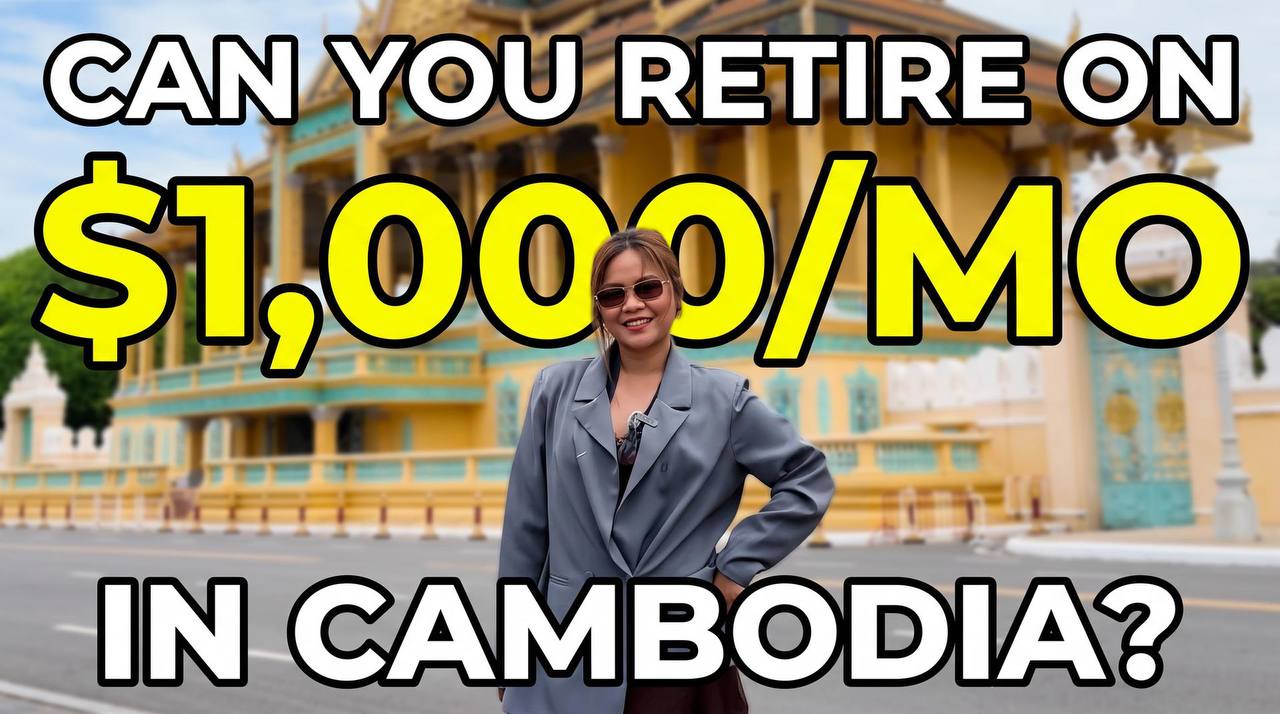
Can You Really Retire in Cambodia for $1,000 a Month? Here’s the Honest Breakdown
Can You Really Retire in Cambodia for $1,000 a Month? Here’s the Honest Breakdown
By Charlotte | Property Consultant, Phnom Penh, Cambodia
If you’ve typed “cheap places to retire abroad” into Google recently, Cambodia has almost certainly shown up on your screen. And for good reason — the Kingdom of Wonder offers one of the lowest costs of living in Southeast Asia, a straightforward retirement visa, and a warm, welcoming expat community.
But there’s a big gap between what you read on a blog and what things actually cost when you’re standing on the ground in Phnom Penh.
I know this because I live here. I help foreigners find apartments every week. I see the real rental contracts, the real utility bills, and the real lifestyle choices that make — or break — a retirement budget.
So let’s break it down with real, current 2026 numbers. No estimates. No outdated pricing from a five-year-old forum post. Real costs, based on life in one of Phnom Penh’s most popular expat neighborhoods: Toul Tom Poung (TTP), better known as the Russian Market area.
Why Toul Tom Poung? A Quick Neighborhood Snapshot
TTP is one of Phnom Penh’s most beloved expat neighborhoods — and for many retirees, it hits the sweet spot between affordability, livability, and convenience.
Unlike the polished glass towers of BKK1 or the riverside buzz of Tonle Bassac, TTP has a lived-in, community-driven feel. Think quieter residential streets, a dense network of independent cafés, casual restaurants, and boutique shops — all orbiting the famous Russian Market, where you can buy everything from fresh produce to handmade crafts.
A 2026 guide published by Cambodianess describes TTP as “lively but still relatively relaxed, with a good balance between local life and foreigner-friendly amenities.” It’s particularly popular with mid-budget expats who want walkable streets, solid coffee, and lower rents than the embassy district — without sacrificing the creature comforts that make expat life enjoyable.
Property prices here are generally lower than in BKK1 or Tonle Bassac. You sacrifice the river views and hotel-style lobbies, but you gain character, community, and a significantly lighter monthly bill.
For a retiree on a fixed income, that combination is hard to beat.
The Full $1,000/Month Budget Breakdown
Let’s go line by line. These numbers reflect a single person living in a one-bedroom furnished apartment in TTP, living a comfortable but not extravagant lifestyle.
🏠 Rent — $350/month
This is the single biggest variable in your budget, and TTP is where you get real value.
A furnished one-bedroom apartment in TTP typically ranges from $300 to $450 per month on a 12-month lease. At $350, you’re looking at a clean, furnished unit — often 45–60 square meters — with air conditioning, a kitchenette, and sometimes a balcony.
For comparison: the same apartment in BKK1 would run you $500–700. That $150–250 monthly difference alone can cover your entire food budget.
Pro tip: signing a 12-month lease (rather than month-to-month or Airbnb) gets you the best rates. Landlords in TTP are generally open to negotiation, especially if you pay several months upfront.
🍜 Food — $250/month
This is where Cambodia shines. If you’re willing to eat like a local, your food costs can be remarkably low.
Here’s how $250 breaks down in practice:
- Local markets and street stalls for fresh produce, rice, eggs, and staples: $100–130/month
- Occasional Western grocery runs (imported cheese, wine, cereal) at Lucky or Thai Huot: $50–60/month
- Eating out at local Khmer restaurants (a good meal costs $2.50–4): $50–70/month
Eating out in TTP is genuinely affordable. The neighborhood is dense with small, family-run Khmer eateries where a bowl of kuy teav (noodle soup) runs about $1.50 and a full rice plate with meat is $2.50–3.50. Even the Western-style cafés — and TTP has excellent ones — rarely charge more than $5–7 for a brunch plate.
If you eat primarily Western food and dine at expat restaurants daily, your food budget will push closer to $400–500. But at $250, you’re eating well, mixing local and Western, and enjoying the best of both worlds.
⚡ Utilities + Internet — $90/month
- Electricity: $50–70/month (air conditioning is the main driver — moderate use keeps this manageable)
- Water: $5–8/month
- High-speed home internet: $20–25/month (50 Mbps, reliable)
- Mobile data: $8–10/month (prepaid SIM with generous data)
TTP apartments are generally smaller and older than the high-rise condos, which actually works in your favor — less space to cool, lower electricity bills.
🛺 Transport — $50/month
Most things in TTP are walkable. The Russian Market, your local café, and several restaurants are likely within a 10-minute stroll.
When you need to go further — to BKK1, the riverside, or AEON Mall — a Grab tuk-tuk ride costs $2–4 within central Phnom Penh. Budgeting $50/month gives you roughly 15–20 rides, which is plenty for a retiree who isn’t commuting daily.
Walking is free, and TTP is one of the more pleasant Phnom Penh neighborhoods to do it in.
🛂 Visa — $25/month
The Cambodia ER (Retirement) Visa costs approximately $290–300 per year, which breaks down to roughly $24–25/month.
Key facts about the ER visa:
- You must be 55 years or older to qualify
- It’s renewable annually without leaving the country
- It does not permit employment — this is a genuine retirement visa
- Most expats use a visa agent, which adds a small service fee (~$30–50/year) but saves hours of paperwork
There’s talk of a monthly income requirement of around $1,500, but in practice, enforcement is flexible and most retirees report that compliance is straightforward.
🏥 Health Insurance — $100/month
Health insurance is the category where I strongly advise against going bare-bones.
A basic international health insurance policy for a retiree in Cambodia runs approximately $80–150/month, depending on age, coverage level, and deductibles. At $100, you’re getting a solid policy with inpatient coverage and emergency evacuation — which matters, because serious medical care in Cambodia often means a trip to Bangkok or Singapore.
Some retirees self-insure (save the premium and pay out of pocket), which can work given Cambodia’s low out-of-pocket costs for routine care — a doctor’s visit is $25–35, and dental cleaning runs $20–30. But for anything major, insurance is worth it.
The Bottom Line: Is $1,000 Enough?
| Category | Monthly Cost |
|---|---|
| Rent (1BR, TTP) | $350 |
| Food | $250 |
| Utilities + Internet | $90 |
| Transport | $50 |
| Visa | $25 |
| Health Insurance | $100 |
| TOTAL | $865 |
At $865 per month for essentials, you’re left with about $135/month in buffer — enough for the occasional night out, a weekend trip to Kampot, or replacing a broken phone.
Can you live on $1,000/month in TTP? Yes. Comfortably? Yes — if you’re intentional about your spending. Lavishly? No.
Here’s the honest truth: your lifestyle determines your budget more than your neighborhood does.
- Lean retirement (studio, local food, minimal nights out): $650–750/month
- Comfortable retirement (nice 1BR, mix of local and Western food, occasional travel): $850–1,050/month
- Urban expat lifestyle (modern condo, daily Western food, regular socializing): $1,200–1,500/month
The gap between “lean” and “lifestyle” is almost entirely your choices: where you eat, how often you drink, and how much space you rent.
What About Other Cities?
$1,000/month in TTP is tight-but-doable. The same budget in other Cambodian cities gives you far more breathing room:
- Siem Reap: Rents are 20–30% lower. A nice 1BR runs $200–300. You could live very comfortably on $750–900/month.
- Kampot: The riverside expat haven. Rents as low as $150–250 for a charming apartment. $700–850/month buys a lovely, slow-paced retirement.
- Sihanoukville: More expensive than it used to be due to Chinese investment, but still cheaper than central Phnom Penh in many areas.
So, Should You Do It?
I’ve helped dozens of foreigners settle into Phnom Penh, and here’s what I’ve learned: the people who thrive are those who come with realistic expectations.
Cambodia is not a polished retirement destination like Portugal or Costa Rica. The sidewalks are uneven, the traffic is chaotic, and the humidity never takes a day off. But it’s warm, it’s affordable, and it’s full of genuine, kind people who will welcome you if you come with an open mind.
If you’re serious about making the move — and you want someone who actually lives here to help you find the right apartment in the right neighborhood — reach out. I’m Charlotte, and I’ve been helping foreigners find property in Cambodia for years.
I’m not here to sell you a dream. I’m here to give you the real numbers, show you real apartments, and help you make an informed decision. Because the best retirement isn’t about the lowest cost — it’s about finding the place that feels like home.
charlotte